
Noticing nature
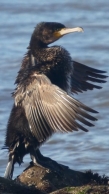
Cormorant
Weather forecasts and tide tables guide where I go to notice nature. Good low tides and I am out on the coastal rock terraces in the lower shore. Less good tides are for noticing nature on coastal cliffs or mid-shore rocks. Unusable tides are when I head for woodland. There is a seasonality to it that is absorbing and from which comes ecological understanding
The year continues to be a bad one for the wolf (1). A devastating illogicality arises when wolves leave the safety of one area where they are protected, only to be slaughtered in an adjacent area where they are not. This happens when wolves stray out of Yellowstone National Park into Montana and where nearly nine in 10 dies within one mile of the park (2). Similarly, when two of the wolves recently reinstated into Colorado strayed into Wyoming, both were killed (3,4). I wrote last year about the Fuorn wolf pack, whose territory included the Swiss National Park where they are strictly protected, but which permission had been egregiously granted to the Canton of Graubünden under a new national policy of culling for the complete removal of the pack when its members stray out of the Park (5). I noted that the Park had long been waiting for the return of wolves, and had put in place a long-term research project of wolf monitoring to determine the influence of wolves. The loss of the Fuorn pack would snatch the ambition of that research from the Park, as it would also leave a continuing hole in its trophic ecology.
At the time of writing back then, I could not bring myself to check whether the slaughter of those wolves had commenced. However, I had to catch up quickly at what had happened over the intervening months when I was asked in early October to comment on a draft proposal for an emergency motion to be tabled at the IUCN World Conservation Congress that condemned the Swiss national policy on wolf culling (6). The motion urged Switzerland to amend its hunting regulations to ensure wolf and wildlife management respected best available science, and that it adhered to the provisions in the Bern Convention on the use of lethal control (6). The motion, which was passed, was an exasperation at the repeated refusal of Switzerland to meet its obligations under the Bern Convention, despite the increasingly stronger wording in the continuously escalating complaints procedure initiated by the Bureau of the Convention, and which is to be discussed again at the next Standing Committee of the Bern Convention in a few days’ time (7-10). I hope the plight of the Fuorn pack is not forgotten in all this, because the Canton of Graubünden and its Office for Hunting and Fishing released information on the 48 wolves that had been “proactively regulated” from 1 September 2024, to 31 January 2025, of which 15 were killed from the Fuorn pack- "Based on the information available to us, we assume that the Vorab and Fuorn packs no longer exist as such” (11,12).
More attentive to the nature that is around me
I may not see wolves back in Britain in what is left of my life, but that does not stop me from having a care for their plight and contributing where I may to preservation of their existence. It has, though, made me more attentive to the nature that is around me, and of which I have written before (13-15). That noticing of nature has continued. It was sad to find the remaining fulmar chick had fledged and left for the open sea on the last day of August. I had been logging the numbers of fulmars on the sandstone ledges at West Cliff, Whitby, since they came back last December (14,16) hoping that it would tell me something about their mating season, but it didn’t. The numbers fluctuated during January to June from a high of 42 down to single figures some days, and occasionally none, but the median was 22. I noticed the first fulmar chick in mid-July when looking down from a vantage point, then two more a couple of days later from the sands below. I was looking forward, like last year (13) to watching the chicks turn from fluffy grey bundles into the sleek whiteness of their head and body and for them to test out their newly formed grey wings.
There were seven fulmar chicks visible by the beginning of August and mostly left on their own with rarely an adult around. I was thrilled to catch a fulmar chick begging an adult and being fed in return (see video in (17)). There were 10 fulmar chicks visible in the third week in August. An additional chick had appeared at the end of a small gulley at the most easterly fulmar location. It must have been hiding further up the gulley, as its head was mostly clear of grey fluff. Then I spotted another new chick at the middle fulmar location as it popped its head up above some vegetation. At first glance It looked pretty advanced in losing its juvenile fluff, and then it exercised its wings (see video in (18)). I moved on to the westerly fulmar location and one of the chicks demonstrated an explosive defecation to ensure that it didn’t foul its nest (see video in (19)). As the development of the chicks progressed, I noticed that even though they can have lost all of their juvenile grey fluff from their head, they seem to have a small tuft of white feathers like a crest. It became 11 fulmar chicks on the 21 August. The eleventh chick had been hiding inside a small cavern in the sandstone cliffs of the headland at the westerly fulmar location. I watched as this chick begged from an adult and eventually was fed. There were periods when I saw little activity from any of the chicks, but then I noticed one exercise its wings six times in succession (see video in (20)).
After a break of a few days, I went down to the sands below the cliff ledges again, but could only find seven chicks, meaning that some had fledged and gone. I’m never sure whether this is an accurate count as they hide very well. Then the next day, I found only two chicks. How rapid things had moved on. The one remaining at the middle location looked restless and eventually did a few wing flaps, but I was too slow to video it. The one left at the westerly location was a bit dozy to start with but then also got restless. The next day, only the westerly chick was left. I was pretty sure I witnessed it very seriously thinking about its first flight. In the end, it turned back from diving off the cliff (see video in (21)). It was gone the next morning. I should have been happy for its next phase of life, but I was so sad that all the chicks had gone.
The sand martins, my other summer bird friend (13) turned up at their nesting colonies in the sand lenses above Upgang Beach at the end of April. Over the weeks, I watched them fly in groups of 30 or more, checking out each of the nesting colonies in turn and fly in and out of the holes in the sand (see video in (22)). To my surprise, I noticed two other nesting colonies this year, making a total of five. By mid-June, I saw the first evidence that sand martin chicks had been born in those nest holes, as there were multiple faces at the entrances to the holes – adults would fly in to feed them (see video in (23)). The faces at the entrances were gone by mid-July, and the sand martins were back to flying in groups, presumably with the fledged chicks as part of them. All the sand martins were gone by the end of August.
A good addition for noticing nature
My nature noticing started to get a bit thin come September, the chronology of native wildflowers on the coastal grassland slope on West Cliff had run its course, with fleabane again being one of the last to flower (13). I had also been logging the wildflower species on two vegetated slumps or ledges about 35m and 80m in length along the soft cliffs above Upgang Beach, both of these being below sand martin nesting colonies. It was the latter that had enticed me up onto those ledges with the hope of getting a better view of the sand martins. Once there, I realised I should compare what grew on the ledges with what I saw on the coastal grassland slope.
Many species were common to both, especially the leguminous wildflowers, such as birds foot trefoil, kidney vetch, tufted vetch, and restharrow. There was more sea plantain on the ledges than can be seen on the grassland slope, and there was only the common spotted orchid when the grassland slope has that orchid and three others (13). One of the ledges has wet patches where jointed rush (Juncus articulatus) grows. This ledge alone had carline thistle (Carlina vulgaris) flowering in July, a biennial that has a distinctive brown-and-golden flower, their dead heads persisting for many months afterward. There was also devil’s-bit scabious (Succisa pratensis) there in mid-September, the last wildflower I saw on either the coastal slope or ledge grasslands to come into bloom. I ran these wildflower species sightings for the ledges through RMAVIS, an application for assigning vegetation data to National Vegetation Class (NVC) communities (24) and it returned “MC9 Festuca rubra–Holcus lanatus maritime grassland”. However, it has been noted that because few studies have been carried out, much of the coastal vegetation of soft cliffs may not fit any of the currently recognised NVC communities (25).
It was sitting on the larger ledge that I was sometimes joined by a kestrel (Falco tinnunculus) that perched on a small cliff-edge mound above me. It would take off and glide along the cliff face above the ledge grasslands, stopping occasionally to hover if it caught sight of the movement of a small mammal. Kestrels also hunt over the coastal grassland slope on West Cliff, but there is nowhere for them to perch where there would be as good a view as on the ledge. While I have not seen any small mammals, like a shrew or vole, these coastal grasslands would be their space, with its range of different tall grasses and litter layer in which they hide, breed and feed. The indication of the presence of small mammals by the hunting kestrel, the seasonal presence of sand martins and wildflowers, made the ledges a good addition for noticing nature.
Snow as a telltale
Autumn is the time to search for fungi. I made repeated visits to the secondary birch wood on Ugglebarnby Moor and was shocked when I realised that between mid-September and the end of October, my list of species had reached 21, including fly agaric (Amanita muscaria) brown ear cup (Otidea spp.) puff ball (Lycoperdon perlatum) grey-spotted amanita (Amanita excelsa) tawney grisette (Amanita fulva) birch bolete (Leccinum scabrum) and penny bun (Boletus edulus). Thus, in yet another way, that woodland had surpassed expectations - how did those fungi get there? (14) The wood got a bit of a battering by Storm Benjamin around the 24 October, but the broken boughs added to its complexity and it was still my sanity space. It preyed on my mind, though, that I may have been missing out on the colourful fungi that could grow in the adjacent Scots pine plantation, a dismally artificial space that I rarely visited. However, I ventured in and found a bright red brittlegill fungus that was sickener (Russula emetica) and the beautiful orange gills, fluted trumpet shape of the cap, and red stalk of the false chanterelle (Hygrophoropsis aurantiaca). A less colourful species was the grisette (Amanita vaginata).
On a whim, I peeked out on to the open moor when I next went to the birch wood at the end of October. I had a brain wave. The heather moor is scattered with isolated large pine trees as well as pine and birch seedlings. I wondered, would there be pine woodland fungi under the isolated pines on the moor? The pines would have to be large enough to have exerted enough shade to clear the understorey of heathland. The first one I checked right on the edge of the birch wood had a badger latrine. I headed across to another and found sickener. The next one had false chanterelle. On I went, and found one with both sickener and false chanterelle, as well as others that had either, perhaps eight altogether. How did they get there?
Both fungi are basidiomycetes that produce windblown spores that are ellipsoidal in shape and are miniscule (<10 μm)(26,27). There is an estimate that a cubic metre of air in temperate climates can contain 1,000-10,000 fungal spores, a majority of which are basidiospores (28). Sickener is an ectomycorrhizal fungus that forms a mutualistic symbiotic relationship with the roots of pine (26). When the spores land on a moist, acidic area with a coverage of organic matter, the conditions that are created by needle drop under pines, they germinate and form hyphae (29). These thread-like filaments wrap around the root tips of the tree and through them exchange takes place of water uptake and nutrient. In contrast, false chanterelle is a saprophytic fungus that obtains nutrients from decaying organic matter in conifer litter and decomposing wood (27). It secretes oxalic acid, a reducing agent and relatively strong acid (30). This stimulates weathering of the humus layer of forest soil, and influences the solubility and turnover of nutrients - particularly phosphorus and nitrogen - which in turn affects their availability for use by forest trees. Given that these two fungi are distributed in the conifer plantation right up to its edge, then the spores of the sickener and false chanterelle would have had to travel between 100-300m across open heathland, and over bands of high gorse at the longer distance, to get to these isolated pines. Astonishing.
A first snowfall came at the end of the third week of November, which at lower ground turned quickly to slush. Two days later, at its higher altitude (202m asl) there was still a layer of snow 7-10 cm deep in the birchwood that was not only great fun but educational. It provided a brilliant telltale of recent roe deer use of the woodland. The multiple imprints of deer toes going both ways in a narrow band in the snow showed their recent passage along trails. I was pleased to see that those trails were the same paths that I take in the woodland, although I did observe a deer trail because of the snow that I didn’t know existed. Once inside the bulk of the birch woodland, individual deer seemed to disperse off trails, presumably looking for food. I follow those trails by sight, but under snow the deer must know them by instinct and memory. Another telltale were deer scrapes that I often see in the woodland, but it is not easy to determine when they had been created. A sure sign of fresh scrapes was shown by a shallow, elliptical brown hollow in the snow showing the organic material of the ground layer and with the scrapings lying on top of the snow. One final bit of evidence of the presence of roe deer was a scattering of their droppings on top of the snow along a trail – the shiny black droppings were cylindrical and pointed at one end, rounded at the other (31). I rarely see the roe deer in this woodland, despite all the evidence they leave there, and so these telltale signs were a delightful confirmation of their recent presence.
Sensitivity of birds to human disturbance
I have been lucky this year to have seen pods of bottlenose dolphins (Tursiops truncatus) an inshore species, moving through the sea from three locations, once from Filey Brigg (see video in (32)) twice across Saltwick Bay (see video in (33)) and from the end of Beadnell Point in Northumberland. There are volunteer groups that monitor dolphin movements along the NE coast at Scarborough (34) and Newbiggin (35) the former more an alert system for movements, whereas the latter does a roundup of monthly sightings along the coast. There is also a rolling record of recent sightings for Yorkshire and NE England that have been submitted to the Sea Watch Foundation, a national charity working to improve the conservation and protection of whales, dolphins and porpoises in British and Irish waters (select Yorks & NE England in (36)). The apparent increase since 2018 in dolphin numbers along the NE coast would make for an interesting story, if only there was published confirmation of this population increase. My dolphin sightings are by chance, but I set off in mid-September to see the mix of common (Phoca vitulina) and grey seals (Halichoerus grypus) of the Ravenscar colony loafing on the rocks at Low Nook at the southern end of Robin Hoods Bay (37). It was a long flog around the bay at low tide. I could hear strange noises as I got closer. Surprisingly, I only saw two teenagers hauled out which I avoided, the larger adults were either beached on a reef (see video in (38)) or spaced out in the sea near the rocks, perhaps over 50. There was a loud, haunting wail coming from the ones in the water. I suspect it was a congregational thing, a form of social communication like wolves howling with each other.
The passage of dolphins drops off during the winter (39). I was disappointed that I didn’t capture the seals wailing in my videos – I was too close to a waterfall that ran down the coastal cliff and which masked the wailing sound – but I’m not going to flog that far again this year around Robin Hoods Bay. However, a week in early October walking the low tide rock terraces up in Northumberland, where there always seems to be many more waders, especially at Harkness Rocks N of Bamburgh, convinced me that there was winter nature to notice. I had already seen the reappearance in September of purple sandpipers (Calidris maritima) (e.g. (40)) and the less numerous red knot (Calidris canutus) in amongst the scraggly patches of coral weed (Corallina officinalis) and pepper dulse (Osmundea pinnatifida) to the edges of the rock terrace at mean low water by Saltwick Nab, they both having returned from their summer breeding, the purple sandpiper in eastern Canada, Scandinavia and Svalbard (41) and the red knot in Iceland, Greenland and the Canadian Arctic (42). There were also curlews (Numenius arquata) redshank (Tringa totanus) and oyster catchers (Haematopus ostralegus) feeding on more extensive patches of coral weed and pepper dulse on the rock terrace below mean low water on the western side of the Nab. Purple sandpipers are fun to watch, as they are less likely to scatter at my approach, unlike curlews and oyster catchers, both of which vocally complain if I as much turn in their direction. Redshank are somewhere in between.
The day before I saw the purple sandpipers, I had also seen turnstones (Arenaria interpres) that had returned from High-arctic Canada and Greenland (43). They were feeding in amongst the semi-circular pile of large rocks that sit on the sands immediately opposite the spillway between West Pier and its extension in Whitby. I suspect the rocks function as armour protection, put in to break the surge of water that comes through the spillway until the tide has receded. In terms of its position in the intertidal zone, the length of time it spends exposed, it’s probably just into the lower shore, based on the seaweeds that exist on the rocks, more of which later. There were also two juvenile guillemots (Uria aalge) perching on a couple of the rocks, one of them ignominiously swept off by a wave. It landed on the pebble bed at the base of the spillway and I watched as it flapped its wings (see video in (44)).
I noticed that the waders out on the low tide rock terraces up in Northumberland seemed more cautious than those I see at Saltwick and near West Pier. I was reminded that I had a review of human disturbance distances for avian species, the more tolerant a species, the shorter the distance before the bird becomes alarmed and flees (45). It was a useful exercise to go through the species that I had seen in recent weeks, including on the terraces at Harkness Rocks, where I was careful not to get too close to a mixed group of mostly turnstones with redshank and ringed plover (Charadrius hiaticula) and the wigeon (Anas penelope) and shelduck (Tadorna tadorna) that I saw at a distance amongst hundreds of birds on the vast mudflats of the mile wide Budle Bay that is further N of Bamburgh (46). Purple sandpipers and kestrel were rated in the review as low/medium sensitivity to disturbance, oyster catchers, red knot, and redshank as medium sensitivity, eider (Somateria mollissima) as medium/high, and curlew, wigeon, shelduck and ringed plover as high sensitivity (45). My observations were that while the general order of sensitivity to disturbance out on the rock terraces in Northumberland seemed to hold true, it depended on whether the birds were loafing, actively feeding, in mixed groups, or were content to be nearer to areas of disturbance, such as the eiders in the outer harbour at Seahouses that take advantage of a fresh water drain outlet but also on the off chance that they may get fed. The latter was interesting, as the review noted that habituation to disturbance may lead to toleration of shorter distances. It also notes a difference in sensitivity to disturbance between breeding and non-breeding seasons, and considers a range of buffer distances that can be used to protect birds from human disturbance.
Winter bird friends
When I returned in late October to the rocks below the point of extension of West Pier, I saw purple sandpipers as well as turnstones (see video in (47)). That location became my go-to place to make up for the seasonal loss of fulmars and sand martins, the purple sandpipers and turnstones becoming my winter bird friends. On a subsequent visit in early November, a youngish cormorant (Phalacrocorax carbo) was sat on one of the rocks, alert to all the threats of people and their dogs walking along the sands, but content to dry its wings when the sun came out. A mixed flock of purple sandpipers and turnstones flew in as I approached, which was what I was hoping for. However, before I could get to my inconspicuous perch amongst the rocks, all the birds were scattered by dog walkers encroaching too close along the sands. The cormorant went fishing. I sat and waited. A rock pipit (Anthus petrosus) flew in and fed (see video in (48)). A lone purple sandpiper returned. Then more purple sandpipers and turnstones came back in dribs and drabs, a recurring pattern I would see after there was a scattering disturbance. My patience was rewarded when I was able to notice a turnstone turning stones in the low-tide pebble bank in front of the spillway (see video in (49)). I could hear the chinking of the stones, but it didn’t come out on the video soundtrack. I made three more visits at low tide across November, seeing turnstones, purple sandpipers and rock pipits feeding in amongst the rocks, as well as a pair of cormorants sat on a rock, one of which was vainly intent on dozing (see video in (50)).
What makes those rocks a draw for the sandpipers and turnstones is that the seaweeds growing there create the niches in which they find their food. Like terrestrial species, marine species show communities of association and which vary depending on what they grow on or in, their intertidal position, and the level and energy of wave exposure they experience (51). The rocks near West Pier have, in varying amounts, brown seaweeds such as bladder wrack (Fucus vesiculosus) serrated wrack (Fucus serratus) and knotted wrack (Ascophyllum nodosum) with its growths of reddish-brown filamentous epiphytic algae siphon weed (Polysiphonia lanosa); the red seaweeds of false Irish moss (Mastocarpus stellatus) bead-weed (Lomentaria articulata) that is found in shady places, and sand binder (Rhodothamniella floridula) that covers large areas of the rocks and binds with sand to form a spongy, carpet like mass; and sparse amounts of the green seaweeds of sea lettuce (Ulva Lactuca) and the annual gutweed (Ulva intestinalis). Where they are not covered in sand binder, the rocks have common rock barnacles (Semibalanus balanoides) and scattered common limpets (Patella vulgata) and there are beadlet sea anemones (Actinia equina) attached low down to the rocks. The nearest marine community that fits this list of species is “Rhodothamniella floridula on sand-scoured lower eulittoral rock”, a habitat of intertidal rocks with barnacles and brown seaweeds on a moderately exposed shore (52,53). This community, and the low-tide pebble bank in front of the spillway, supports invertebrates such as seaweed flies (Coelopa frigida) crustacea including small crabs and amphipods, molluscs such as periwinkles (Littorina littorea) as well as polychaetes, the marine annelid worms, that purple sandpipers, turnstones and rock pipits eat when they forage on these intertidal rocks and pebble bank before they get covered as the tide comes back in (54-56).
I headed off across the sands to my go-to place a few days ago, but a familiar sound stopped me in my tracks - the fulmars were back on the ledges again (57). I counted 31 fulmars, maybe half in pairs. However, my noticing nature is not about counting species. I notice nature for what it tells me about how it lives, how it distributes, and what space it needs away from the disturbance of people. It’s a purposeful absorption that fills my days.
Mark Fisher 6 December 2025
(1) The right to existence of a non-human species, Self-willed land March 2025
www.self-willed-land.org.uk/articles/shoot_shovel_silence.htm
(2) What happens when wolves leave Yellowstone, Nick Mott and Mike Koshmrl, Montana Free Press 17 November 2025
https://montanafreepress.org/2025/11/17/what-happens-when-wolves-leave-yellowstone/
(3) How many of Colorado’s wolves can die before experts raise the alarm? Ali Longwell, The Aspen Times 28 May 2025
(4) Survival rates of Colorado’s reintroduced wolves are falling below a critical threshold, Chase Woodruff, Colorado Newsline 4 June 2025
https://coloradonewsline.com/2025/06/04/survival-rates-colorado-reintroduced-wolves/
(5) The scientific wilderness, Self-willed land October 2024
www.self-willed-land.org.uk/articles/scientific_wilderness.htm
(6) Motion 142 - Upholding science-based wildlife conservation in Switzerland, IUCN World Conservation Congress 2025
https://iucncongress2025.org/assembly/motions/motion/142
(7) Meeting of the Bureau 10-12 September 2024, Standing Committee 44th meeting, CONVENTION ON THE CONSERVATION OF EUROPEAN WILDLIFE AND NATURAL HABITATS T-PVS(2024)11
https://rm.coe.int/tpvs11e-2024-bureau-meeting-10-12-september-2755-8761-8314-1/1680b1ea91
(8) Meeting of the Bureau 8-10 April 2025, Standing Committee 44th meeting, CONVENTION ON THE CONSERVATION OF EUROPEAN WILDLIFE AND NATURAL HABITATS T-PVS(2025)04
https://rm.coe.int/tpvs04e-2025-report-1st-bureau-meeting-8-10-april-2025-2782-0569-6781-/1680b5d441
(9) Meeting of the Bureau 16-18 September 2025, Standing Committee 45th meeting, CONVENTION ON THE CONSERVATION OF EUROPEAN WILDLIFE AND NATURAL HABITATS T-PVS(2025)16
https://rm.coe.int/tpvs16e-2025-report-3rd-bureau-meeting-16-18-september-2025-2749-2184-/488029301e
(10) Standing Committee 45th meeting, Strasbourg, 8-12 December 2025, CONVENTION ON THE CONSERVATION OF EUROPEAN WILDLIFE AND NATURAL HABITATS T-PVS/Agenda(2025)21Ann
https://rm.coe.int/agenda21e-annotated-2025-45th-standing-committee-as-2783-0208-4369-1/48802985a1
(11) Bilanz der Präsenz und Regulierung des Wolfs im Jahr 2024, Kanton Graubünden 10 March 2025
https://www.gr.ch/DE/Medien/Mitteilungen/MMStaka/2025/Seiten/2025031001.aspx
(12) Faktenblatt Wolfspräsenz und Wolfsregulation 2024/2025, Amt für Jagd und Fischerei Graubünden
(13) A natural life – the self-will of existence, Self-willed land August 2024
www.self-willed-land.org.uk/articles/intrinsic.htm
(14) The ecological integrity of ancient woodlands, Self-willed land June 2025
www.self-willed-land.org.uk/articles/cock_mill_larpool.htm
(15) Being deceived about the importance of temperate rainforest for wild nature, Self-willed land August 2025
www.self-willed-land.org.uk/articles/rainforest_nature.htm
(16) Mark Fisher (@selfwilledland.bsky.social) Bluesky 18 December 2024
https://bsky.app/profile/selfwilledland.bsky.social/post/3ldlb77cbvc2l
(17) Fulmar chick begging and being fed, sandstone cliffs, West Cliff, Whitby 6 August 2025
www.self-willed-land.org.uk/articles/fulmar_chick_begging_feeding.MP4
(18) Mark Fisher (@markwilderness) Twitter 18 August 2025
https://twitter.com/markwilderness/status/1957375008222626031
(19) Fulmar chick with explosive defecation, sandstone cliffs, West Cliff, Whitby 21 August 2025
www.self-willed-land.org.uk/articles/fulmar_explosive.mp4
(20) Fulmar chick flapping its wings, sandstone
cliffs, West Cliff, Whitby 28 August 2025
http://www.self-willed-land.org.uk/articles/fulmar_chick_poop_wingflap_long.MP4
(21) Fledged fulmar chick deciding whether to take its first flight, sandstone cliffs, West Cliff, Whitby 29 August 2025
http://www.self-willed-land.org.uk/articles/fulmar_chick1_thinking_about_it.mp4
(22) Mark Fisher (@markwilderness) Twitter 3 May 2025
https://twitter.com/markwilderness/status/1918582413187310025
(23) Mark Fisher (@markwilderness) Twitter 16 Junne 2025
https://twitter.com/markwilderness/status/1934662313438540211
(24) RMAVIS, UK Centre for Ecology and hydrology
(25) Common Standards Monitoring Guidance for Maritime Cliff and Slope Habitats Version August 2004
(26) Russula emetica (Schaeff.)Pers. - The Sickener, First Nature
https://www.first-nature.com/fungi/russula-emetica.php
(27) False chanterelle (Hygrophoropsis aurantiaca) First Nature
https://www.first-nature.com/fungi/hygrophoropsis-aurantiaca.php
(28) Halbwachs H, Bässler C (2015) Gone with the wind – a review on basidiospores of lamellate agarics. Mycosphere 6(1), 78–112
https://www.mycosphere.org/pdf/Mycosphere_6_1_10.pdf
(29) Tree health and ectomycorrhizal fungal communities, Forest Research
https://www.forestresearch.gov.uk/research/tree-health-and-ectomycorrhizal-fungal-communities/
(30) Fransson, A. M., Valeur, I., & Wallander, H. (2004). The wood-decaying fungus Hygrophoropsis aurantiaca increases P availability in acid forest humus soil, while N addition hampers this effect. Soil Biology and Biochemistry, 36(11), 1699-1705.
https://publications.slu.se/?file=publ/show&id=51818
(31) Watching Deer, The British Deer Society
https://bds.org.uk/information-advice/out-about/watching-deer/
(32) Mark Fisher (@selfwilledland.bsky.social) Bluesky 25 Septdmber 2025
https://bsky.app/profile/selfwilledland.bsky.social/post/3lzoilzbalk2d
(33) Mark Fisher (@markwilderness) Twitter 8 September 2025
https://twitter.com/markwilderness/status/1965059789249241345
(34) Scarborough Porpoise, Facebook
https://www.facebook.com/ScarboroughPorpoise/
(35) Newbiggin-by-the-Sea Dolphin Watch, Facebook
https://www.facebook.com/groups/NEWILDDOLPHINMONITORINGPROJECT
(36) Recent Sightings, Sea Watch Foundation
https://www.seawatchfoundation.org.uk/recentsightings/
(37) The Ravenscar Seal Colony, Wild Outdoors, 26 October 2024
https://wildoutdoors.uk/2024/10/26/the-ravenscar-seal-colony/
(38) Mark Fisher (@selfwilledland.bsky.social) Bluesky 12 September 12
https://bsky.app/profile/selfwilledland.bsky.social/post/3lynr64y7yc2x
(39) Five year monthly total for BND Newbiggin Survey 2019 -2023, Facebook
(40) Mark Fisher (@selfwilledland.bsky.social) Bluesky 21 September 2025
https://bsky.app/profile/selfwilledland.bsky.social/post/3lzds6fxih22z
(41) Purple Sandpiper (Calidris maritima) BTO
https://www.bto.org/learn/about-birds/birdfacts/purple-sandpiper
(42) Knot (Calidris canutus) BTO
https://www.bto.org/learn/about-birds/birdfacts/knot
(43) Ruddy Turnstone (Arenaria interpres) Birds of the World, Cornell Lab
https://birdsoftheworld.org/bow/species/rudtur/cur/introduction
(44) Mark Fisher (@selfwilledland.bsky.social) Bluesky 7 September 2025
https://bsky.app/profile/selfwilledland.bsky.social/post/3lybc34ha4c2l
(45) Goodship, N.M. and Furness, R.W. (MacArthur Green) Disturbance Distances Review: An updated literature review of disturbance distances of selected bird species. NatureScot Research Report 1283
(46) Lindisfarne NNR--Budle Bay, eBird
https://ebird.org/hotspot/L1267143
(47) Mark Fisher (@selfwilledland.bsky.social) Bluesky 22 October 2025
https://bsky.app/profile/selfwilledland.bsky.social/post/3m3sekvii222y
(48) Rock pipit feeding on the rocks between West Pier and its extension, Whitby 7 November 2025
www.self-willed-land.org.uk/articles/rock_pippit.mp4
(49) Mark Fisher (@selfwilledland.bsky.social) Bluesky 7 November 2025
https://bsky.app/profile/selfwilledland.bsky.social/post/3m52fedoyhc2p
(50) Pair of cormorants sitting on a rock between West Pier and its extension, Whitby, 23 November 2025
www.self-willed-land.org.uk/articles/stop_waking_me_up.mp4
(51) The Marine Habitat Classification for Britain and Ireland Version 22.04, JNCC
(52) Rhodothamniella floridula on sand-scoured lower eulittoral rock (LR.MLR.BF.Rho) Description of biotope or habitat type, Marine Habitat Classification, JNCC
https://mhc.jncc.gov.uk/biotopes/jnccmncr00000372
(53) Rhodothamniella floridula on sand-scoured lower eulittoral rock, MarLIN
(54) Purple Sandpipers, All about Birds
https://www.allaboutbirds.org/guide/Purple_Sandpiper/lifehistory
(55) Ruddy Turnstone (Arenaria interpres) DataZone for Birdlife
https://datazone.birdlife.org/species/factsheet/ruddy-turnstone-arenaria-interpres#Ecology
(56) Rock Pipit (Anthus petrosus) RSPB
https://www.rspb.org.uk/birds-and-wildlife/rock-pipit
(57) Mark Fisher (@selfwilledland.bsky.social) Bluesky 3 December 2025
https://bsky.app/profile/selfwilledland.bsky.social/post/3m737rnutmc2p
url:www.self-willed-land,org.uk/articles/noticing_nature.htm
www.self-willed-land.org.uk mark.fisher@self-willed-land.org.uk